Friday, 17 September 2010

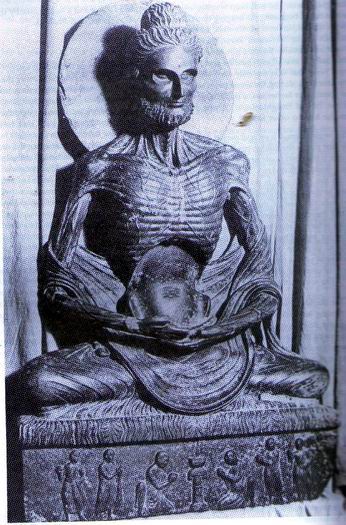
Focus On: Emaciated Buddha

As part of an on-going* theme--Art of the Week from the Indiana University Art Museum! The work this time is an Emaciated Buddha from 2nd century Gandhara. Now, here is the bummer part--this image is NOT the work from the IU Art Museum. I found the correct image on their website, but it seems to be under copyright, so I can't use it. But do check out the link to look for it, because it is a really nice piece.
(Thanks to azibaza.com for the image, which should at least give you an idea of what another Emaciated Buddha from Gandhara looks like.)

The IU Buddha is smaller, and depicts the torso, head, and halo (might be a mandorla, but I don't think it is) of the Buddha. As far as I know, Buddha (Siddhartha Gautama, as he was then) departed from his family's wealthy enclave for a life of aestheticism, as he was looking for a way to find enlightenment. After 6 years (that was the time frame given on the museum label, anyway) Gautama decided that meditation and moderation were a better way to go than straight starvation, and he modified.

Why did I pick this artwork? Because in person the sculptural affect of it is astounding, the way all of the veins, ribs, and disturbing details are rendered. Gandhara would be modern-day Pakistan, Afghanistan, and Northern India, and you can see some of the Greco-Roman/Hellenistic influences in the wavy hair of the Buddha, which isn't as common in Buddhist depictions further South or East. These images of Buddha definitely remind me of Greek icons, which reminded me of something which I learned from watching QI (so it obviously must be true!): companies that make devices to detect people trapped in rubble take samples of the breath of fasting monks, particularly at Mount Athos in Greece, because this is the closest smell to human starvation, which the devices need to be able to pick up.

It's all SO macabre. But I can't help but be interested in ascetic practices and how they play out in art. Like how certain saints are renowned for their asceticism, yet they are often depicted as robust and healthy (cough St Jerome cough cough) . Or nuns who were purported to live on the Body of Christ alone--I mean, it's no wonder they were having visions!! In one of my art class we're looking at diffusion of art styles between "the West" and Islam, so this has been much on my mind lately, and it's cool that you can see that in the Emaciated Buddha.

*"on-going" in the sense that this is the second time I'm doing it.

Wednesday, 15 September 2010

The Runcible Spoon

They dined on mince, and slices of quince,
which they ate with a runcible spoon.
And hand in hand, on the edge of the sand,
They danced by the light of the moon,
the moon, the moon.
They danced by the light of the moon.
--"The Owl and the Pussycat," Edward Lear, 1971

I can vividly remember the illustrations in "The Owl and the Pussycat" book that my mom used to read to my sister and me. What I didn't realize until I was looking it up tonight is how SHORT the actual poem is. It's three stanzas! When I was little, it seemed so long.

Digressions aside, the reason I was looking up "The Owl and the Pussycat," and more specifically, the enigmatic runcible spoon, was that I went to a restaurant over the weekend called the Runcible Spoon! We wanted a quick--and cheap--bite before heading to a movie, and the Spoon was right on the way. It's housed in a converted Victorian-y looking house, with an umbrella-ed patio in the front. The interior boasts wooden plank tables in various shapes and sizes, a windy staircase, and a nice soothing coffee smell.

The food? Good. Really good, especially for the prices (my dinner was $6, with tax and all). I got a "Black Russian," which is basically a vegetarian Reuben. I admittedly really like Reubens (the main reason I can never be a true vegetarian, I think) but the Black Russian was a good substitute, with sauteed (but not mushy!) vegetables in place of the corned beef. It was on reaaaaally awesome dark rye bread, with a side of "smashed" potatoes, which turned out to be more like a tasty potato pancake. It's mostly sandwiches and all day breakfast, with some good veg/vegan options (one of the people I was with is vegetarian, and she vouches for their black bean soup). I think they might have pasta too.

Anyway, check it out! It kind of reminded me in Rent of the Life Cafe where they all jump up on the tables and sing "La Vie Boheme." I feel like something like that could happen at the Runcible Spoon some evening.

Oh, and a runcible spoon? "Runcible" is a word that Lear made up, and he uses it to describe different things in different works. It has also been defined as a pickle fork, or a spoon with a cutting edge, although in Lear's drawing of it, it just looks like a ladle. For even more oddness, check out "The Owl and the Pussycat," set to music by Igor Stravinsky.

Monday, 13 September 2010

A T-Shirt is Worth a Thousand Words

I have an "Ithaca is Gorges" shirt, which I deeply love. And other people do, too--every time I wear it, I get comments on it from strangers. In Brooklyn it was a good conversation starter with my neighbors ("Ithaca! It's so pretty up there"), the doctor at the hospital ("did you go to Cornell? My daughter did"), people in bars ("I'm from Rochester! Let's talk about Wegmans!"), the library ("I was in Syracuse once. GO ORANGE!"), and random people on the subway.I was not expecting the same Ithaca-excitement in Indiana. However, I was proved wrong. People in class (some I knew, some I didn't) told me it was funny. A guy in the bookstore gave me the up-and-down look, and said, "cool shirt" before sidling off. Best of all, I was on the bus (actually, having just sent my Brooklyn cousin a text saying, "why does the Ithaca shirt make people so excited?") when an older man got on; a professorial type with long, graying hair.

He sat behind me and kind of leaned over. "Cornell?" he said, "or Ithaca U?" " Oh, neither," I replied. "I went to school in Geneva, so I'm from the area." He paused for a few seconds. "William Smith, right?" he said.

I could have given him a hug. I've been having to explain my alma mater repeatedly since being here, and it gets a little old. Coordinate system, Finger Lakes, small liberal arts, "it's right in between Rochester and Syracuse," etc. My professors, by and large, know of Hobart and William Smith Colleges, but the other students don't. Which I suppose is only fair enough--I've never heard of their small Southern and Western liberal arts colleges, either. The only school name I've recognized so far is Sewanee. So I don't know why I feel that New York schools should be known by all, even though most of them have never been to New York. Probably an East Coast bias on my part.

So, it was nice not to have to explain, and even nicer that this guy had gotten the "William Smith" part right, instead of just calling it "Hobart," which happens a majority of the time. Which is majorly infuriating. But anyway. After I squeaked out, "yes!! William Smith," he said, "I lived in Ithaca for 20 years." Well! We had much to discuss--mostly, vineyards, Trumansburg, Cuba's garlic festival, Taughannock Falls, Wegmans (obviously), and how it does not snow nearly as much in Indiana as it does in Ithaca.

He said that Bloomington is equivalent to Ithaca in a lot of ways--Farmer's Market, artsy stuff, live music, and food, but it's not quite as cool. I had been getting an Ithaca-vibe as well, while walking around downtown. While I love Ithaca (and would live there, for sure), I have been known to make fun of it, too. Self-righteously liberal academics, eat-fresh-produce-or-you'll-die mentality, wear only all natural hemp, a slight snobbishness--it lives up to those stereotypes sometimes, I think. But for a few minutes on the bus, a stranger and I bonded over how much we miss New York. And I've got that t-shirt to thank.

Saturday, 11 September 2010

Focus On: Käthe Kollwitz

I am kind of surrounded by art thought and art theory all. the. time. now, but one thing I'm not really doing is writing about it. So, what I think I will do is talk about one work a week from the Indiana University Art Museum.

Yesterday I went to a little lecture/tour in the museum's print collection. Prints, unlike most other works of art, can't really be on view most of the time--the paper is really sensitive to light and other conditions, so most of the time, prints are not on view at IU. You can make appointments to see specific works, but they have also decided to open up the space one Friday each month, and lay out about 20 prints on the tables. The curator talks about them, and then you can walk around and look. The theme this month was German Expressionism.

I know a little bit about German Expressionism, because my undergrad institution has some in their collection, but most of it is new to me. There was a strange mix of people for the lecture--some students, but mostly older community members. I met another young woman outside the gallery, and after chatting I know that she doesn't go to IU, is here in town with her fiance, who is a chemistry PhD candidate, she is originally from South Carolina, she used to do lithography and printmaking, and she gave me some winery tips. We were really hoping that they had some of Käthe Kollwitz's work.

And here she is:
(Death, Woman and Child, 1910. Thanks to MoMA online for the image--IU's online images are bad/nonexistent. They are working on it.)

It's a powerful print, made more so by the fact that it is straight-up gorgeous. It's so smooth and modeled and gentle, and it seems like the mother and child are fused together, while some dark, ominous cloud in the upper portion is pulling them apart. If you look very closely, you can see the child's fingers gripped tightly in the mother's hand. It's enough to break your heart.

As my new printmaking friend and I were looking at Death, Woman and Child, an older, elegantly dressed woman came and stood next to us. She began to speak in a lilting German accent. "In my hometown, Cologne, there is a Käthe Kollwitz museum, in one of the cathedrals. Her father was a socialist and her husband a doctor, and they both influenced her art by introducing her to many poor people, who were often her subjects. She and her husband lived in the slums where he treated his patients. Her son died in World War I, and her grandson in World War II." She looked at her hands. "She knew pain. So much pain in Germany, then, yes." She is right. What else is there to say?

Kollwitz commented on living and working in scenes of abject poverty: "It was not until much later...when I got to know the women who would come to my husband for help, and incidentally also to me, that I was powerfully moved by the fate of the proletariat and everything connected with its way of life.... But what I would like to emphasize once more is that compassion and commiseration were at first of very little importance in attracting me to the representation of proletarian life; what mattered was simply that I found it beautiful."

This grieving mother and child, if not a scene that Kollwitz often saw, was certainly something that she would have encountered. And the thing is, she's right--the image is beautiful. And terrible. All at the same time.

Wednesday, 8 September 2010

Come si dice...?

I am taking Beginning Italian and I have my first quiz tomorrow. Not a big deal--mostly a few verbs (essere, avere, stare), forms for singular and plural, and definite and indefinite articles. The only thing I'm a little nervy about are the definite articles, since we just learned those last night, and there seems to be an awful lot of forms for them. Still and all, Italian. My thoughts?

It's gorgeous. I'm in a class that is specifically for grad students who need to read it, so it's not very much speaking, but even when we make tragic attempts to say it--it's beautiful. I took German my senior year, and lemme tell you--not the same at. all. Even of the tiny range of words I know, there are some goodies--professoressa (professor, female), motocicletta (motorcycle), cuarantacinque (55), luglio (July), abbastanza bene (pretty good), not to mention all the musical terms--andante, adagio, allegretto, scherzando, and dolce! It makes my mouth feel nice to say these things.

And the place names! We had to read a little paragraph about the regions of Italy. Try these on for size: Liguria, Lombardia, Trentino-Alto Adige, Friuli-Venezia Giulia, Abruzzi, Campania, Basilicata. I've wanted to go to Italy ever since, well, I saw a slide of a Titian painting. Learning a little bit of the language is making me feel like I will get there. And until then, I'll be perfecting my lasagne making techniques and getting ready to hang with the dudes at the Marco Polo club in Jamestown!

(Also, it's annoying when Americans--who know Italian--order "a panino" or "biscotto" even those are the correct singular forms of panini and biscotti. Just sayin'.)

Sunday, 5 September 2010

Saturday Sun

Saturday sun came early one morning
In a sky so clear and blue
Saturday sun came without warning
So no-one knew what to do.
--Nick Drake, Saturday Sun

Yesterday was gorgeous. It's been so hot here (as it has been everywhere!) and suddenly the temperature dropped about 20 degrees and it was sunny sunny sunny and 75. I ventured out to downtown in the morning and wandered around a bit--I'm still trying to orient myself to where the courthouse/the square is in relationship to Restaurant Row, the public library, and campus.

So here's the courthouse: (as seen in Breaking Away, lest you were curious)
Then I met up with two awesome family friends for lunch. Their daughter is my sister's roomate (hiya, ARLES), and it is really great for me that they're here, because 1. they can give me directions and other life help, 2. they brought me a bag of pears that they picked, 3. they are super nice, and 4. we had falafels and baklava and chatted.

After lunch, we wandered around the Fourth Street Art Festival for a bit, which was jam-packed with stalls, people, and live music. A lot of fiddling. (I'm getting into blue-grass country now, I keep forgetting.) Any art you could really think of--I was impressed the most with glass weaving, some of the photography (a REALLY cool technique where you have two cameras and take the picture through the second camera, which is positioned behind the first, so it's through two lens's, if that makes any sense), and quite a few different pottery booths. Some very cool rice bowls, some (overpriced yet gorgeous) shawls, abstract painting, metal-worked wall plaques, jewelery, wooden cookware, and much more!

Here are two not so great shots, but you can kind of tell how big it was:

Along the way I met up with some Art History ladies and we went to get gelato, wandered some more, and went home to prepare for the AHA (Art History Association) picnic, which was, again, lots of fun and lots of good food. (I don't know who provided those sweet potato tart things and the peach cake, but mmmm!) It has been nice to meet some of the older MA and PhD students, although I confess to being a terrible networker and not meeting as many people as I should! I'm getting there though. After THAT we went to a few places downtown for drinks, very late night pizza, and some general frivolity. So much frivolity, in fact, that it is almost noon and I just staggered out of bed, with 70 pages of Leon Battista Alberti leering at me, just waiting to be read. I will probably make some brownies to console myself.

To sum up: Saturdays in Bloomington, so far, involve food, art, and new friends who I am really getting to like. Yeah, I could get used to this.

Wednesday, 1 September 2010

And the Title is...

After asking for help on naming this here blog, I had a lot of suggestions from you, both on here and on facebook. And I've decided on:
Indi-Anna
(Subtitle) Remaking my Mind & Other Adventures

I was torn between my cousin's suggestion of "In Di Anna's Mind," or the simpler "Indi-Anna." ("Indiana" and "Anna" lend itself to good possibilities.)

So Nan really gets the prize (whatever that is) for coming up with "Remaking my Mind," which I think is great, and Roger and my mom reiterated the "Indi-Anna" decision, so they should probably get a prize too. We'll see what I can come up with!

It's Wednesday morning, my third day of class. I just made a big breakfast--bacon, scrambled eggs with onion and cheese, tea, and bread (it should be toast, of course, but I don't have a toaster). This is big news, because as anyone who knows me well knows that while I am delighted when others provide me with breakfast (make me pancakes and we'll be friends forever), I don't make breakfast for myself. Yesterday I had orange juice, Oreos, and baby carrots with hummus.

I'm already realizing that grad school is VERY different from anything else I've experienced before. It's so much free time, but so much reading that I have to set routines or I'm not going to do anything. Hence, the big breakfast. And on that note, I need to go wash some pans.

Thanks for the blog help!